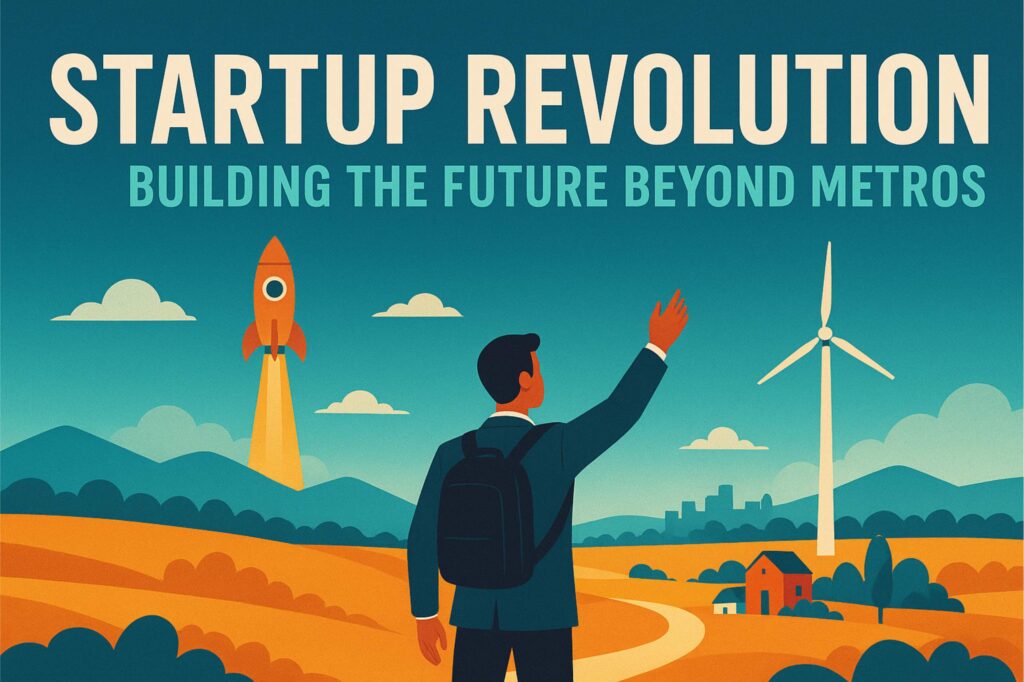
India is fast emerging as a global innovation powerhouse, home to nearly 2 lakh recognized startups and around 122 unicorns — making it the third-largest startup ecosystem in the world. As the country marches toward becoming the world’s third-largest economy, the momentum of innovation is gradually shifting from major metros to Tier-II cities, which are poised to redefine India’s entrepreneurial map.
These cities, once perceived as support zones, are now becoming the leaders of innovation. They offer distributed R&D, lower operational costs, and deeper cultural alignment—creating conditions for talent to thrive where purpose outweighs proximity. For India, this distributed innovation is not just decentralization—it’s democratization.
The North East: A New Startup Frontier
In the North East Region (NER), entrepreneurship has evolved rapidly over the past decade, with each state designing its own startup policy framework. While growth here is comparatively slower than in metropolitan hubs, a silent revolution is underway. Young entrepreneurs are embracing innovation, digital solutions, and new aspirations, fueled by technology and connectivity.
Startups in the North East span diverse sectors—reflecting both the region’s natural advantages and cultural richness:
Agriculture & Allied Sectors: Agri-tech, food processing, and animal husbandry startups leverage the region’s biodiversity and agro-resources.
Handloom & Textiles: Innovators breathe new life into age-old crafts, combining traditional designs with contemporary markets.
Tourism: Eco-tourism, travel tech, and community-based hospitality ventures harness the region’s pristine landscapes.
IT & ITES: Digital transformation is taking root through software, AI, and platform startups.
Retail & Logistics: Entrepreneurs are solving last-mile connectivity and market linkage challenges.
Health & Wellness: Telemedicine and wellness product startups cater to local and national demand.
Edutech: Digital learning and skill-based education startups empower youth at the grassroots.
Waste Management & Renewables: Green startups tackle sustainability through recycling and renewable energy.
Media & Entertainment: Emerging creators amplify regional voices on digital platforms.
This sectoral diversity demonstrates how tradition and modernity can coexist within a localized innovation framework, with agriculture and allied enterprises leading the charge.
Current Ecosystem Landscape
The North East now counts over 2,000 DPIIT-recognized startups and around 30 operational incubators, of which nearly 80% are housed in academic institutions. However, most startups remain in ideation or early launch stages, with roughly 80% following “me-too” models rather than breaking new ground through scalable innovation.
Key challenges that still constrain regional growth include:
- Limited access to seed and venture capital funding.
- Insufficient mentorship and professional guidance.
- Shortage of skilled manpower and technical expertise.
- Weak market access and regulatory support.
To unlock growth, the startup ecosystem must evolve from enthusiasm-driven to structure-driven, integrating education, funding, mentorship, and market linkages into a cohesive policy and practice framework.
A Roadmap for Strengthening the North East Startup Ecosystem
A targeted roadmap can make the North East a major contributor to India’s innovation-driven economy:
1. Build an Entrepreneurial Talent Pipeline
- Embed entrepreneurship education at school and college levels.
- Shift youth mindset from job-seeking to job-creating.
- Create ideation labs and pre-incubation platforms in institutions.
2. Expand and Strengthen Incubation Capacity
- Develop sector-specific incubators in agri-tech, handloom, and tourism.
- Fund and upgrade incubation infrastructure with advanced technology labs.
- Train incubator leaders, mentors, and support professionals to ensure sustainability.
3. Enhance Access to Funding
- Increase grant-based seed funding and simplify government scheme access.
- Build regional VC networks and promote investor awareness.
- Encourage alternative finance models — crowdfunding, angel networks, and impact investment.
4. Provide Continuous Mentorship and Technical Support
- Establish a diverse mentor pool covering business strategy, technology, legal, and market access domains.
- Partner with national institutions for mentor exchange and venture scaling.
5. Foster Innovation and Scalability
- Create innovation clusters linking startups, academia, and industry.
- Promote R&D partnerships for product innovation and export readiness.
- Support startups with advisory and market integration for global outreach.
6. Promote Inclusive and Sustainable Entrepreneurship
- Encourage startups addressing local socio-economic and environmental challenges.
- Design dedicated programs for women and underrepresented founders.
- Nurture “social unicorns” in education, healthcare, clean energy, and community empowerment.
Towards an Atmanirbhar North East
To quote a guiding principle: “Every research should become a product, every product an industry, and every industry the strength of India.”
For the North East, realizing this vision requires strong convergence — connecting Startup India, Standup India, and One District One Product (ODOP) initiatives with traditional industries, MSMEs, and technology enablers. When local innovation meets design, digital tools, and market access, the region can truly emerge as a vibrant startup corridor—a growth engine that reflects both resilience and rootedness. The future of India’s startup story will not just be written in its metros—but in the valleys, hills, and towns of the North East, where purpose, creativity, and community converge to redefine progress.